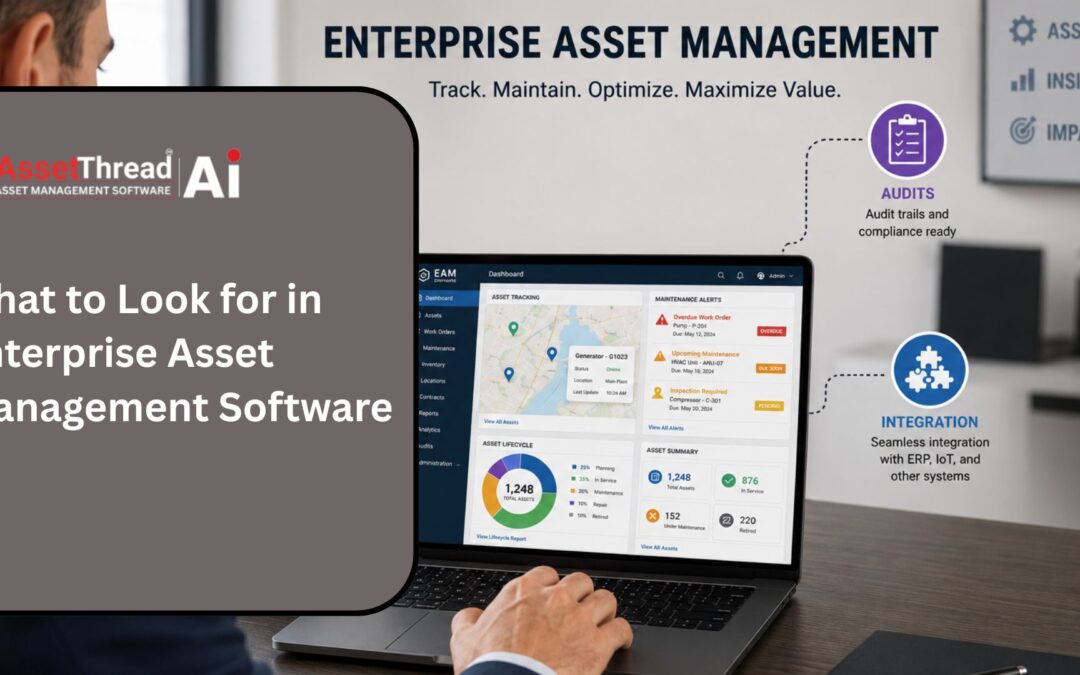
To maximize productivity, minimize business expenses and maintain proper records, organizations need to manage their business assets properly. The more a business expands the more complex its asset management becomes, and it is crucial to invest in the right enterprise asset management software solution. A well-designed solution allows organisations to keep track of their assets, manage their maintenance schedules, monitor asset performance and expand asset visibility within departments.
But it isn’t every asset management system that is capable of the same features. These are some of the attributes that companies need to watch out for when selecting a solution: features, reporting tools, and scalability. These are some of the important considerations that organisations must take under its consideration in order to choose the software that will cater their present needs and future expansion.
Key Features to Look for in Enterprise Asset Management Software
The benefits of an asset management program will largely rely on the characteristics that it offers. What businesses need to work towards are solutions that are simple and efficient. Businesses should push for solutions that are easy to use and work efficiently for them.
Centralised asset management is one of the most crucial aspects. Organisations need to keep maintenance history and records, as well as warranty information and details of their operation, on a single platform. This helps make it easier to see and prevents important information from going astray.
Another advantage of RFQ is that it is possible to track it in real time. It’s an advantage to businesses to understand where assets are located and how they are being used and when they need maintenance. Real time visibility leads to more efficient allocation of resources and reduces downtime.
Other extras to look out for include:
- Asset lifecycle tracking
- Maintenance scheduling and reminders.
- Mobile accessibility
- Reporting and analytics tools
- Audit-ready documentation
- Successful integration on existing business systems/esystems.
Organisations also favor solutions that incorporate a software fixed asset administration feature, which enables a single platform to operate and financial asset documents are managed.
Asset Depreciation and Financial Reporting Capabilities
Financial management is an important aspect of asset management. To make decisions, businesses require precise information on asset value and depreciation, as well as replacement planning.
A modern system will also usually have a depreciation calculation software that can help in tracking depreciation throughout the asset lifecycle. Organisations can quickly and automatically determine depreciation of certain accounting methods, rather than relying on manual spreadsheets.
There are many benefits to implementing automated depreciation management:
- Improved reporting accuracy
- Reduced manual calculations
- Better financial visibility
- Simplified compliance requirements
- Faster audit preparation
Entrepreneurs may additionally produce reports that offer information on asset worth, upkeep prices, and replacement timetables. These reports are useful for financial forecasting and planning purposes.
Tracking depreciation in conjunction with enterprise asset management processes provides organisations with a fuller picture of the assets’ performance and financial impact. This assists Management Teams make optimal investment and operating decisions.
Scalability Considerations for Expanding Organizations
One of the important aspects of asset management is financial management. Depending on the business, it needs to make well-informed decisions about asset value and depreciation, and plan for replacement.
A modern system will also typically include a software for depreciation calculation to assist with keeping a track of depreciation during the asset’s life cycle. Certain accounting methods can be determined to be depreciated – quickly and automatically, without using manual spreadsheet.
There are many benefits to implementing automated depreciation management:
- Improved reporting accuracy
- Reduced manual calculations
- Better financial visibility
- Simplified compliance requirements
- Faster audit preparation
Additionally, entrepreneurs could create reports that provide details concerning the worth of the resources, repair and replacement expenses, and replacement timelines. The reports are helpful for financial forecasting as well as for financial planning.
By monitoring asset depreciation alongside enterprise asset management processes, organisations can get a comprehensive overview of asset performance and financial value. This helps to support Management Teams in making the best investment and operating decisions.
Conclusion
Choosing the right enterprise asset management software involves consideration of functions, budget, and scalability. Some of the top features to look for in a storage solution for businesses are real-time visibility, maintenance management, reporting, and integration capabilities.
When attached to depreciation calculation software, platforms that offer depreciation software for assets make it easier to make sure that the financial side of an organization is accurate, and it offers added value to the asset visibility. In selecting a solution that enables operational efficiency and long-term growth, organisations can optimize their value and improve their overall long-term success in business.
Frequently Asked Questions
Q1. Why is Asset Thread Software important for Indian enterprises ?
A. Asset Thread Software helps businesses improve asset visibility, reduce manual work, and maintain accurate operational records. It also supports better reporting, maintenance management, and long term business efficiency.
Q2. Why do Indian enterprises invest in enterprise asset management software ?
A. Indian enterprises use enterprise asset management software to improve operational efficiency, maintain accurate asset records, and simplify compliance and audit processes.
Q3. How does asset tracking software improve business operations ?
A. Asset tracking software helps businesses monitor asset location, usage, and maintenance in real time. This reduces downtime, improves productivity, and supports better decision making.